Last Updated Jan 17, 2026
The 5-Minute Rule That Could 21x Your Close Rate

The difference between winning and losing a customer often comes down to who picks up the phone first.
You’re elbow-deep in a job when your phone buzzes. New lead. Someone found your website, filled out the form, wants to talk about a project. You make a mental note to call them back when you’re done.
Two hours later, you finally get a free moment. You dial the number. No answer. You leave a message. They never call back.
What happened? They hired someone else. Not because you’re worse at what you do. Not because your prices were higher. Simply because another business called them first.
This scenario plays out millions of times a day across every industry. And the research on it is brutal: respond to a lead within five minutes, and you’re 21 times more likely to qualify that lead than if you wait just thirty minutes.[1]
Twenty-one times. Not 21% better. Twenty-one times better.
That’s not a marginal improvement. That’s the difference between a thriving business and one that’s constantly wondering where all the leads went.
The study that changed everything
The five-minute rule isn’t marketing hype. It comes from one of the most rigorous studies ever conducted on sales response times.
In 2007, Dr. James Oldroyd at MIT’s Sloan School of Management partnered with InsideSales.com to analyze three years of data across six companies—over 15,000 leads and 100,000 call attempts.[1] They wanted to know: does response time actually matter? And if so, how much?
The findings were stark.
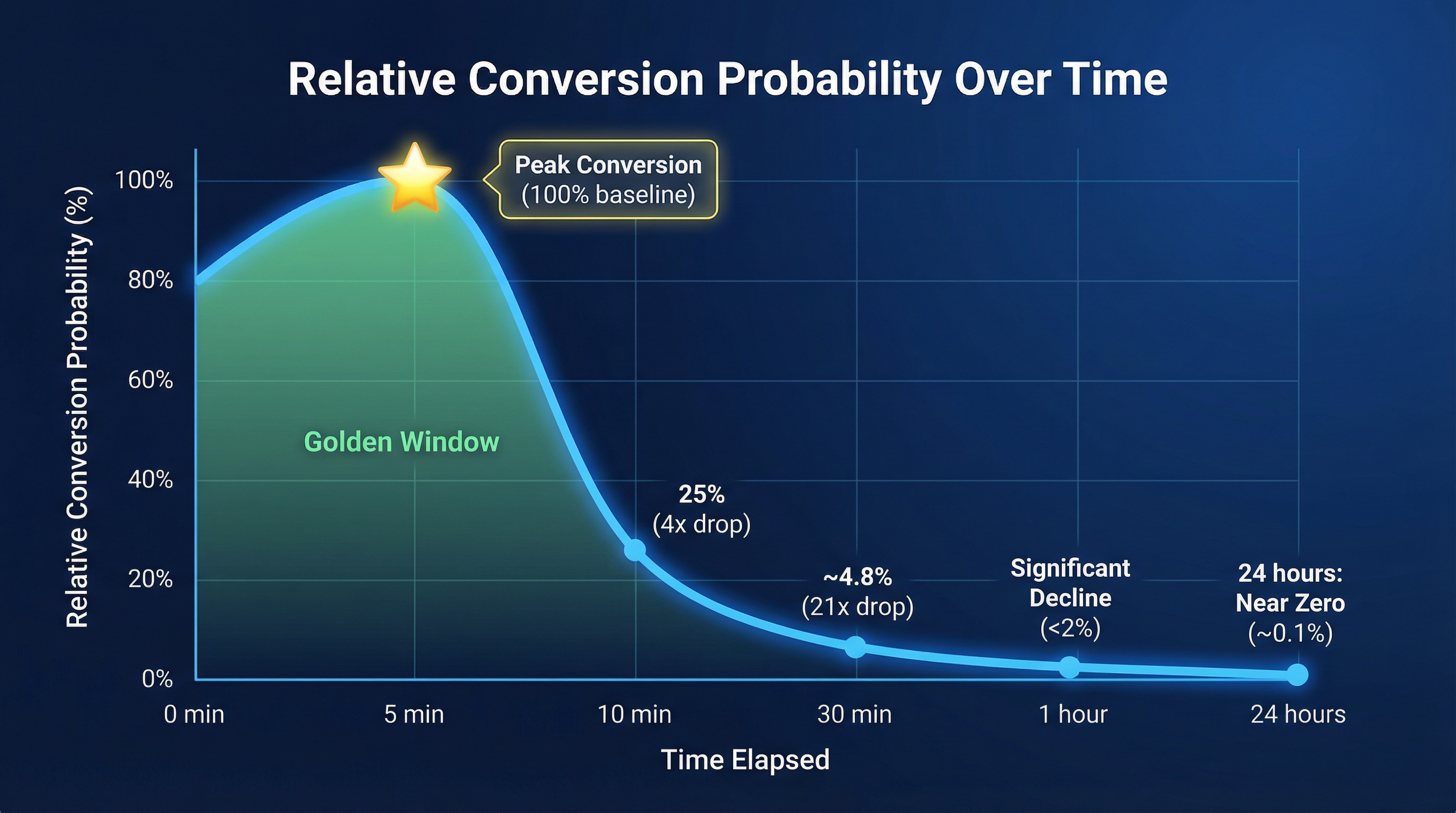
Leads contacted within five minutes were 100 times more likely to be reached and 21 times more likely to qualify than leads contacted after thirty minutes.[1] The drop-off wasn’t gradual—it was a cliff.
Harvard Business Review picked up the research in 2011, auditing 2,241 U.S. companies and analyzing 1.25 million sales leads.[2] Their findings confirmed and extended the original study:
- Companies responding within one hour were 7 times more likely to have meaningful conversations with decision-makers
- They were 60 times more likely to qualify leads than companies waiting 24+ hours
- The average response time across all companies? 42 hours—nearly two full business days
Let that sink in. The optimal response window is five minutes. The average business takes two days.
Why being first matters more than being best
Here’s a statistic that should make every business owner uncomfortable: 78% of customers buy from the first company that responds to their inquiry.[3]
Not the cheapest. Not the most qualified. Not the one with the best reviews. The first one to pick up the phone.
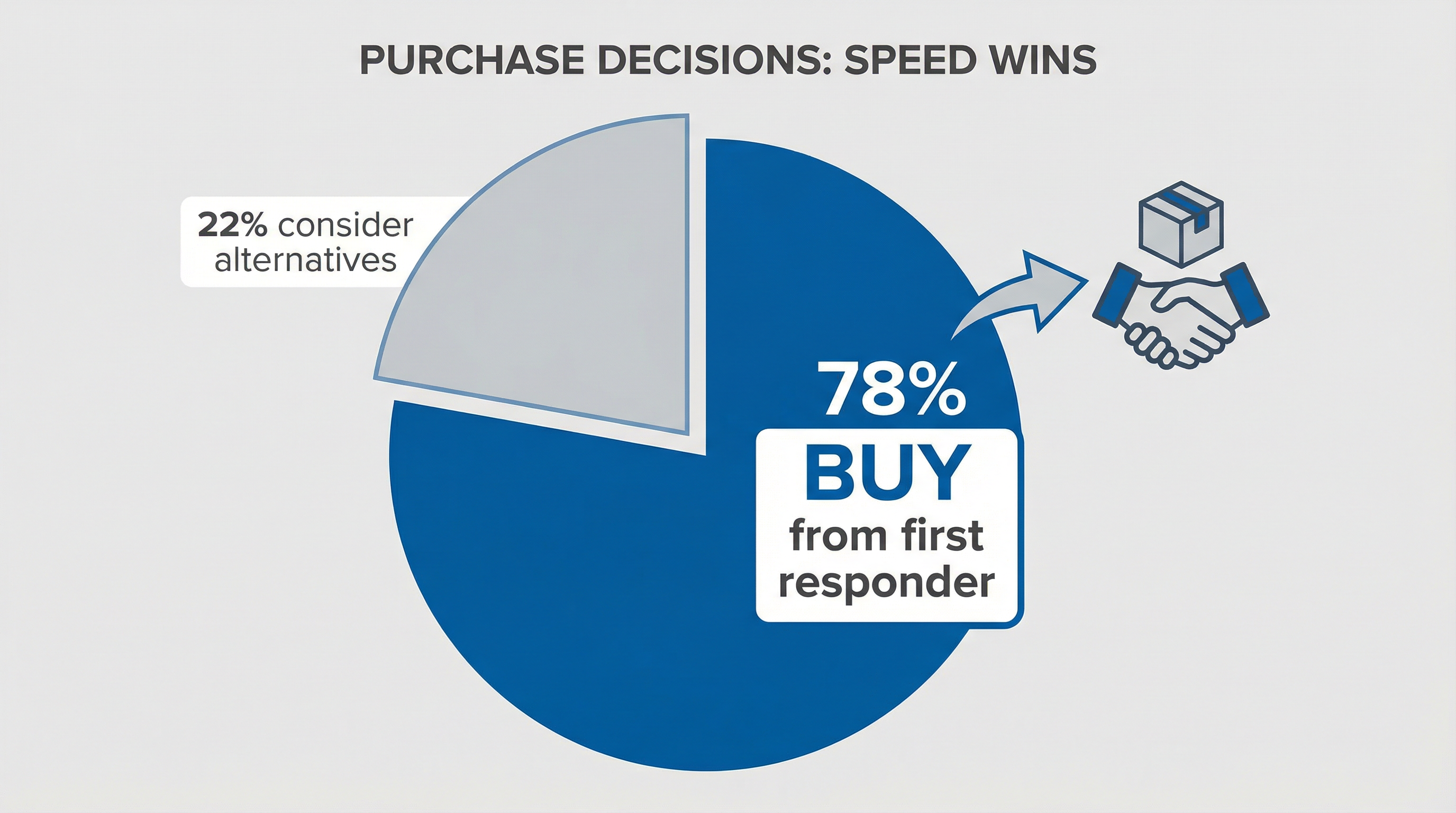
This isn’t irrational consumer behavior—it’s psychology. The primacy effect, documented in research going back to the 1940s, shows that first impressions shape all subsequent evaluations.[4] When you respond first, you set the anchor. You become the standard against which everyone else is measured.
There’s also a practical element. When someone fills out a form or makes a call, they’re in problem-solving mode. They have an active need. That need has a half-life. Wait too long, and they’ve either solved the problem another way, gotten distracted by life, or simply moved on.
Research shows that information stays top-of-mind for about twenty minutes before other priorities take over.[5] After that, you’re not responding to someone actively thinking about their problem—you’re trying to get them to think about it again.
The brutal math of slow response
Most business owners dramatically underestimate how much slow response times cost them.
Let’s do the math for a typical small service business:
- 100 leads per month from website, ads, and referrals
- $2,000 average job value
- Current response time: 2+ hours (faster than average, actually)
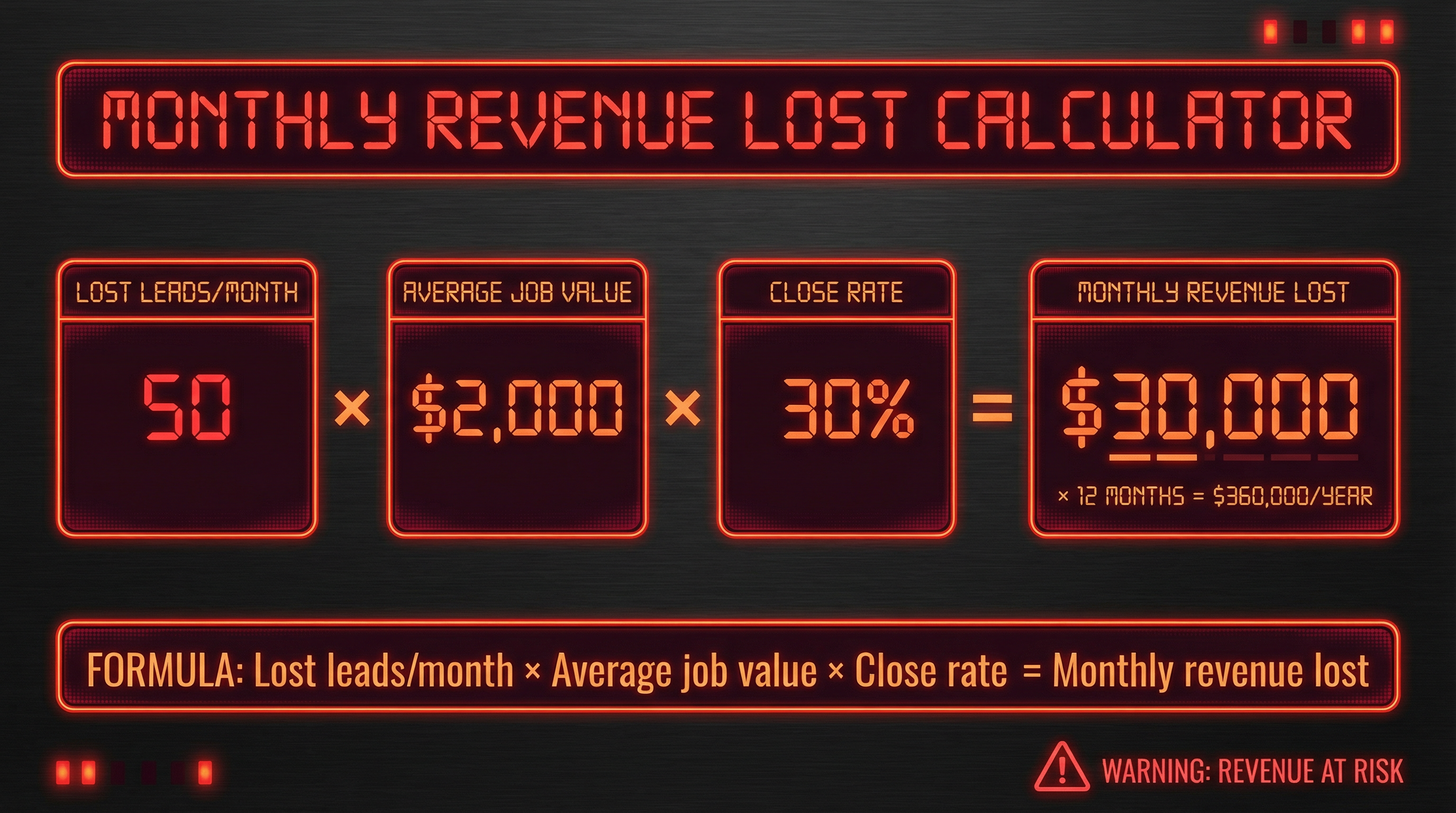
At a two-hour response time, industry data suggests you’re losing roughly 50% of leads to competitors who responded faster.[6] That’s 50 leads per month walking out the door. At $2,000 per job, with even a 30% close rate on the leads you do reach, that’s $30,000 in monthly revenue you never had a chance at.
Annualized: $360,000.
And that’s just immediate revenue. Research shows that customers who have a poor first experience are significantly less likely to refer others or return for future work.[7] The lifetime value impact is even larger.
For context: the U.S. economy spends roughly $4.6 billion annually on B2B lead generation. Studies estimate that $2.7 billion of that is wasted because companies never contact the leads they paid to acquire.[8]
You’re paying for leads. Then you’re giving them to competitors. For free.
Why your response time is probably worse than you think
Here’s what business owners tell themselves: “I’m pretty good at getting back to people.”
Here’s what the data says: probably not.
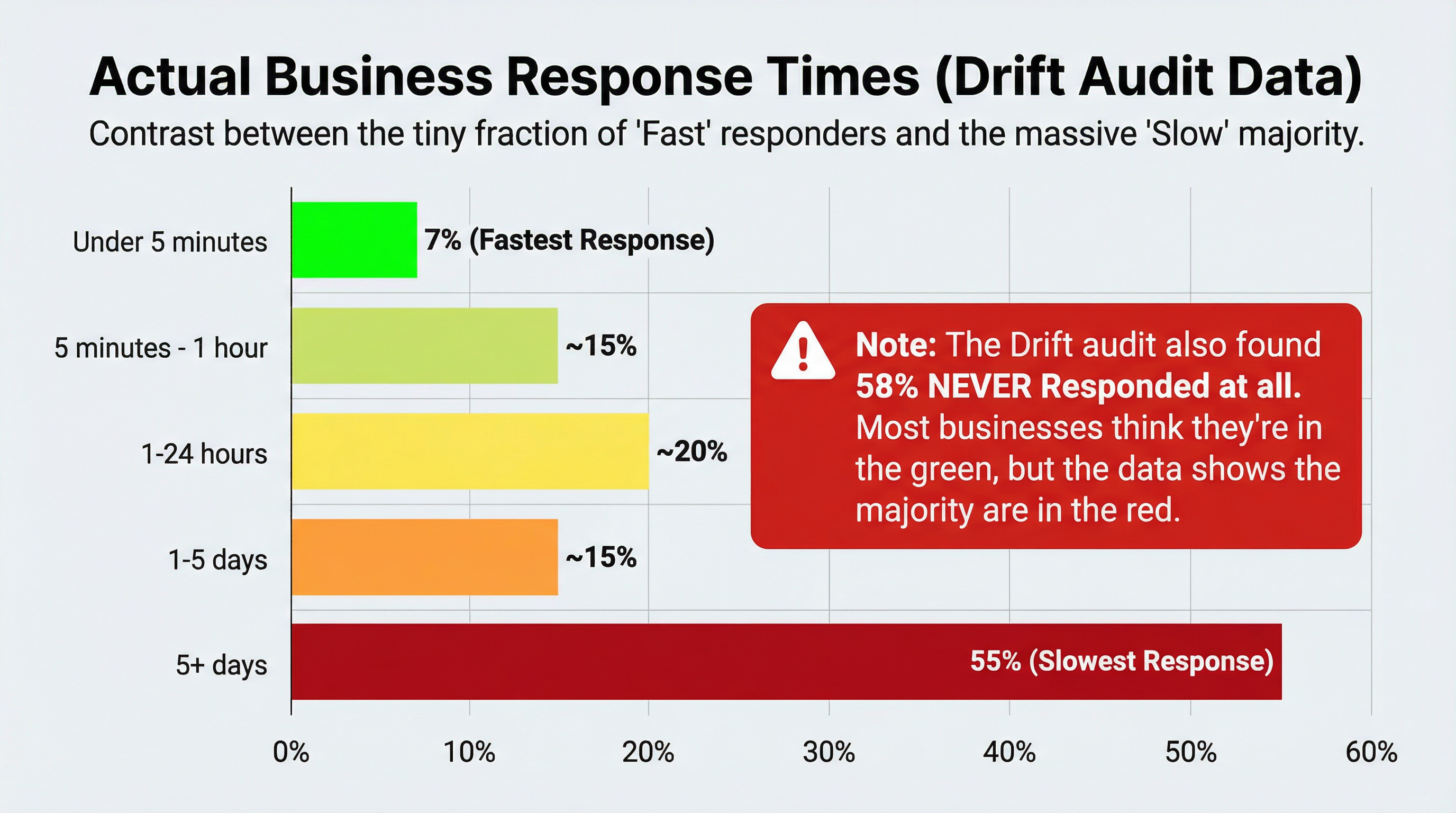
When Drift audited 433 companies’ response times, they found:[9]
- Only 7% responded within five minutes
- 55% took more than five days
- 58% never responded at all
The companies that think they’re responsive often aren’t measuring. They remember the leads they called back quickly. They don’t track the ones that fell through the cracks.
Why businesses respond slowly (it’s not what you think)
The slow response epidemic isn’t laziness. It’s physics.
Small business owners face an impossible problem: the better you are at your core service, the less available you are to capture new business. The plumber can’t answer the phone while snaking a drain. The lawyer can’t take calls during depositions. The salon owner has a client in the chair.
Dr. Gloria Mark at UC Irvine has studied workplace interruptions for decades. Her research found that it takes an average of 23 minutes and 15 seconds to return to an original task after an interruption.[10] For someone doing skilled work—surgery, electrical repair, client consultations—constantly checking for leads isn’t just impractical. It’s dangerous.
Then there’s the timing problem.
Research from ReachLocal, analyzing data from over 3,000 small businesses, found that 23-50% of leads arrive outside of business hours.[11] Evenings. Weekends. Holidays. When you’re closed, your competitors’ AI receptionists are answering.
The data on missed calls specifically is even more sobering:
- 62% of calls to home service companies go unanswered[12]
- 54% of calls to professional services go unanswered
- 85% of callers who don’t reach someone won’t call back—they’ll call a competitor[13]
- 80% of callers won’t leave a voicemail[14]
This creates a vicious cycle. You’re busy serving the customers you have, which means you can’t capture new customers, which means you’re perpetually stuck at the same size—or slowly shrinking as existing customers churn.
What the five-minute rule looks like by industry
The five-minute rule applies everywhere, but the specific dynamics vary by industry.
Real Estate
The National Association of Realtors found that 78% of homebuyers work with the first agent who responds.[15] Even more striking: 70% of homebuyers only interview one agent before deciding.
That means the race isn’t to impress the most buyers. It’s to reach them first.
A Keller Williams study found that 49% of email leads never receive any response, and among those that do, the average response time is over five hours.[16] In an industry where a single commission can exceed $10,000, agents are literally leaving six-figure annual income on the table by responding slowly.
Home Services (Plumbers, HVAC, Electricians)
When someone’s furnace dies in January or their toilet is overflowing, they’re not comparison shopping. They’re calling until someone answers.
Data from Hatch’s 2025 analysis of home service campaigns showed a 10x difference in response rates between the fastest and slowest responders—89.86% versus 8.56%.[17] The difference wasn’t messaging or pricing. It was speed.
For emergency services especially, speed to lead often means speed to only lead.
Law Firms
Hennessey Digital has been tracking legal industry response times since 2021. The good news: 25% of law firms now respond in under five minutes, up from 13% in 2021.[18] The bad news: 39% still take more than two hours or never respond at all.
Martindale-Avvo’s research on what clients want from attorneys found that responsiveness was the single most important factor in choosing representation—above experience, above price, above reputation.[19]
Healthcare and Dental
Dental practices fail to answer approximately 38% of incoming calls during business hours.[20] For every 100 new patient calls, only about 42 result in booked appointments.
One medical practice that reduced email response time from 24 hours to under 10 minutes saw a 40% increase in monthly new patient bookings—without spending an additional dollar on marketing.[21]
What actually works: Strategies ranked by impact
You can’t personally respond to every lead within five minutes. You have other work to do. But you can build systems that respond for you.
Immediate automated acknowledgment
The simplest intervention with the biggest impact.
When someone submits a form, fire off an instant text or email: “Got your message. We’ll call you within [timeframe].” This isn’t a replacement for human contact—it’s a bridge. It tells the prospect they haven’t shouted into the void.
Data shows that businesses implementing automated acknowledgment see 112.6% higher conversion rates on leads that receive a text after initial contact.[22]
The message doesn’t have to be fancy. It just has to be fast.
AI-powered phone answering
Here’s where the math gets interesting.
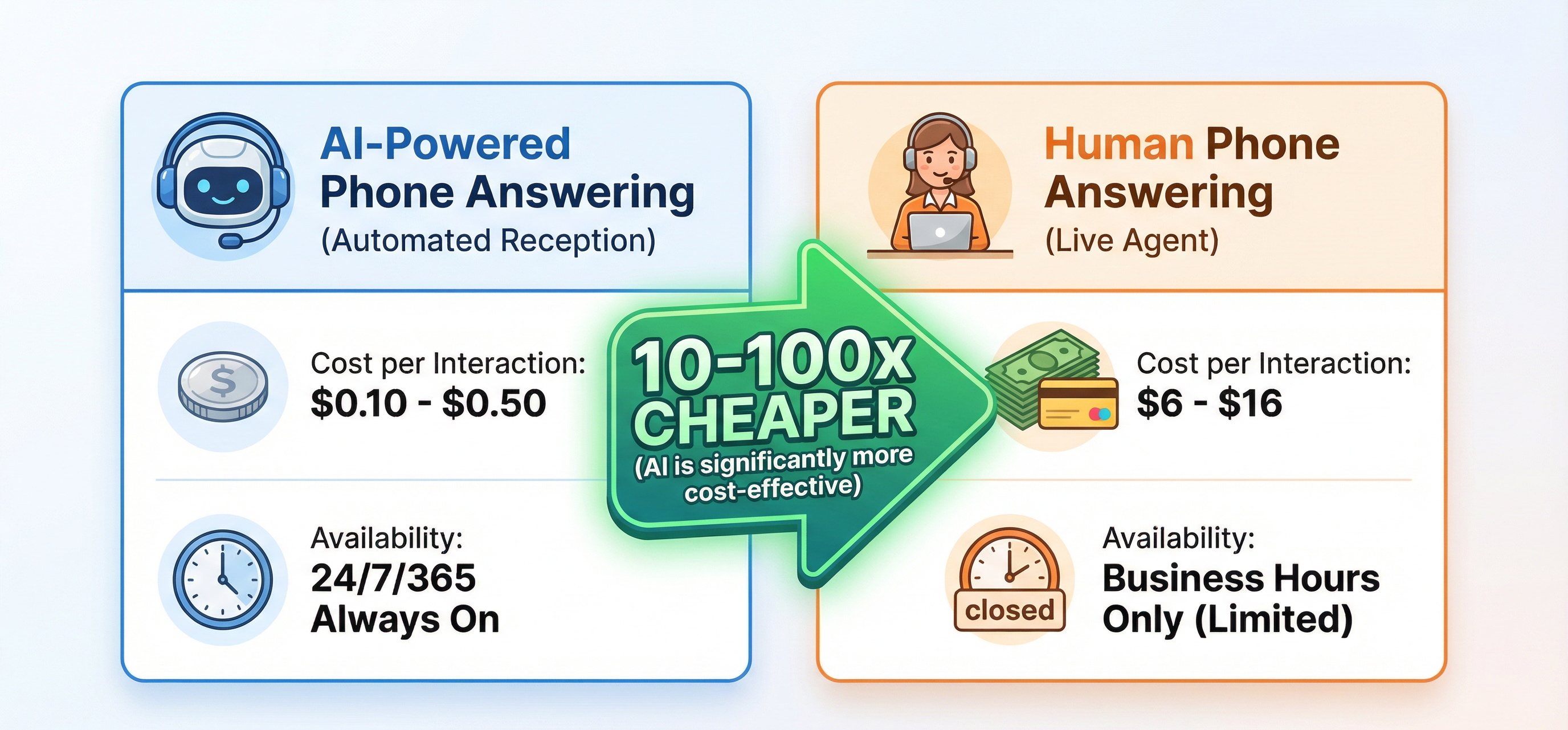
Traditional answering services cost $1-3 per minute and still have hold times, limited hours, and scripts that don’t know your business. An AI receptionist answers instantly, 24/7, at a fraction of the cost.
Customer acceptance has shifted dramatically. Research shows 51% of consumers now prefer interacting with AI when they want immediate service.[23] Another 48% don’t care whether support is human or AI-powered as long as their issue gets resolved.[24]
The cost comparison is stark: a chatbot or AI phone interaction runs $0.10-$0.50, versus $6-$16 for a human phone call.[25]
Text-based response for initial contact
Remember the research on SMS open rates from appointment reminders? The same principle applies to lead response.
- 90% of customers prefer texting with businesses over phone calls[26]
- 98% text open rate versus 20% for email
- Text response rates are 295% higher than phone calls[27]
For initial lead response, a text often works better than a call. The prospect can respond when convenient. You’re not interrupting their day. And you’ve established contact within seconds instead of playing phone tag for hours.
Lead routing and CRM automation
The companies with the fastest response times don’t rely on memory or good intentions. They have systems that automatically:
- Route leads to the right person based on type, location, or availability
- Escalate unanswered leads after defined time windows
- Track response times and flag problems
When Workato audited lead routing implementations, they found companies could reduce average response time from 13 hours to 3.5 hours just through better automation.[28]
Structured follow-up cadence
Here’s a statistic that hurts: 48% of salespeople never make a single follow-up after initial contact.[29] Another 44% give up after just one attempt.
Meanwhile, the research shows 80% of sales require 5-12 follow-up contacts to close.[30]
The solution isn’t to harass prospects. It’s to have a systematic follow-up sequence—one that happens automatically, with appropriate spacing, across multiple channels.
Real results from real businesses
A SaaS company reduced response time from 24 hours to under 5 minutes and saw a 21% increase in conversion rates—without changing anything else about their sales process.[31]
A legal marketing agency worked with firms to improve response from 4+ hours to under 1 hour. Result: 20%+ revenue increases with zero additional marketing spend.[32]
SuperAGI documented businesses implementing speed-to-lead automation achieving 25% higher conversion rates across multiple case studies.[33]
The pattern is consistent: faster response equals more closed business. Not sometimes. Essentially always.
What’s realistic
Let’s be honest about what’s achievable.
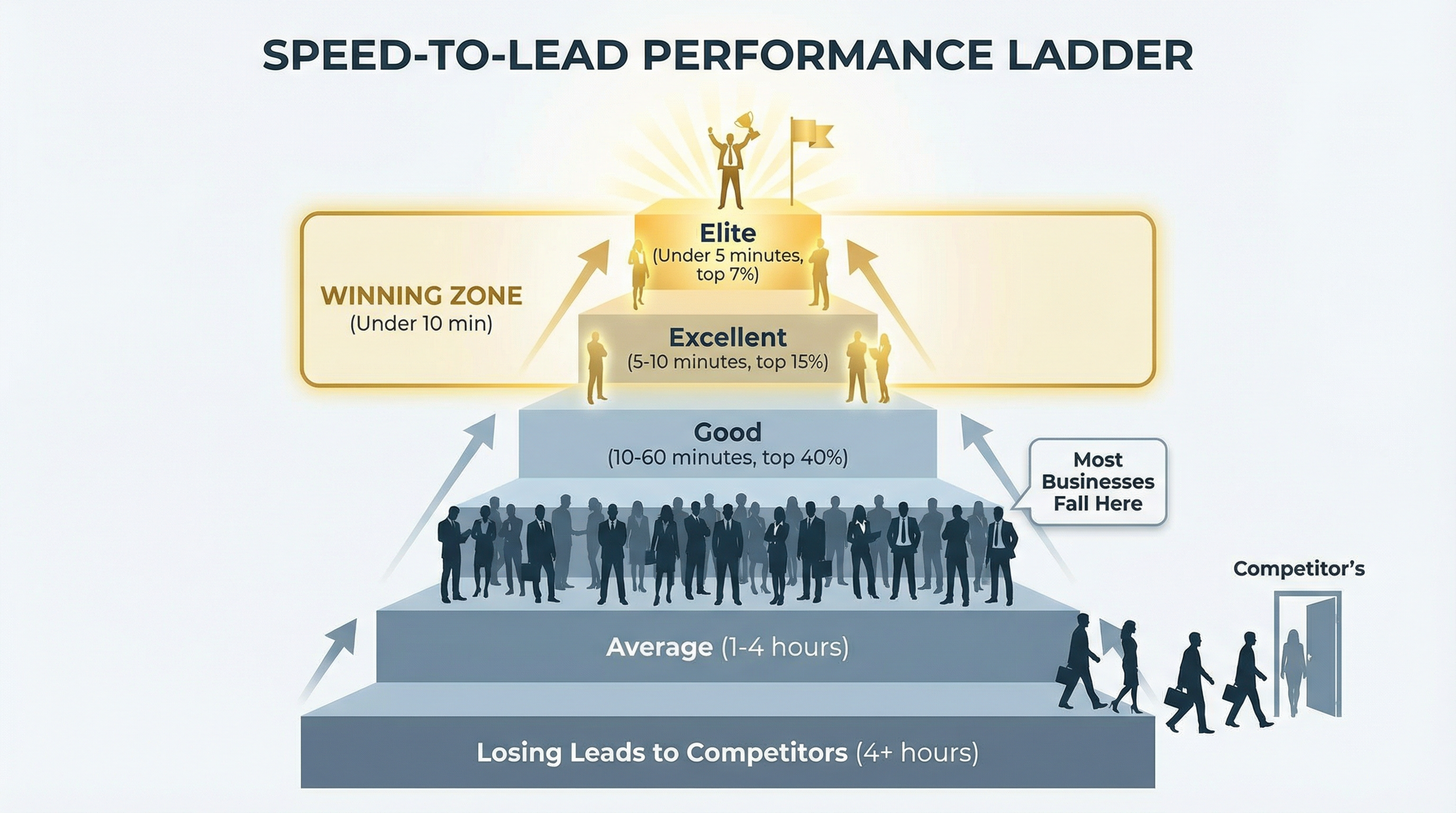
You probably can’t respond to every lead within five minutes personally. That’s okay. The research shows that even getting to under one hour puts you ahead of most competitors. Getting to under ten minutes puts you in elite territory.
Response Time Benchmarks:
- Under 5 minutes: Elite (top 7%)
- 5-10 minutes: Excellent (top 15%)
- 10-60 minutes: Good (top 40%)
- 1-4 hours: Average
- 4+ hours: Losing leads to competitors
The goal isn’t perfection. It’s improvement. If you’re currently at two hours, getting to thirty minutes will make a measurable difference. If you’re at thirty minutes, getting to ten will make another leap.
And if you can get automated acknowledgment out within seconds—even if human follow-up comes later—you’ve bought yourself time without losing the lead.
The bottom line
The five-minute rule isn’t complicated. It’s just math.
Respond faster, close more deals. Respond slower, watch leads walk to competitors. The research has been consistent for nearly two decades across millions of leads and thousands of companies.
The challenge isn’t understanding this. It’s implementing it. Because the same reason you’re reading this article—you’re busy running a business—is the same reason leads are slipping through the cracks.
The businesses that win at speed-to-lead don’t do it through heroic personal effort. They do it through systems: automated acknowledgment, AI-powered answering, structured follow-up sequences, and CRM workflows that ensure nothing falls through the cracks.
Every lead you paid to acquire deserves a response. The question is whether you’ll be the one giving it—or your competitor will.
Sources
- Oldroyd, J. (2007). "The Short Life of Online Sales Leads." MIT Sloan School of Management / InsideSales.com Lead Response Management Study. ↩
- Oldroyd, J. & McElheran, K. (2011). "The Short Life of Online Sales Leads." Harvard Business Review. ↩
- "Speed to Lead Statistics." Vendasta. ↩
- "Primacy and Recency Effects." Simply Psychology. ↩
- "Working Memory and Attention." National Center for Biotechnology Information. ↩
- "Speed to Lead: The Ultimate Guide." Chili Piper. ↩
- "Customer Experience Statistics." Qualtrics. ↩
- "B2B Lead Generation Research." Demand Gen Report. ↩
- "Lead Response Survey." Drift. ↩
- Mark, G. "The Cost of Interrupted Work." UC Irvine Department of Informatics. ↩
- "Small Business Lead Timing Study." ReachLocal. ↩
- "Missed Call Statistics." Invoca. ↩
- Hyken, S. "Customers Will Leave You for Bad Service." Shep Hyken Research. ↩
- "Call Center Metrics." RingCentral. ↩
- "Home Buyer and Seller Generational Trends." National Association of Realtors. ↩
- "Half of Real Estate Leads Never Get a Response." Inman. ↩
- "Speed to Lead in Home Services." Hatch. ↩
- "Law Firm Response Time Study." Hennessey Digital. ↩
- "What Clients Want from Attorneys." Martindale-Avvo. ↩
- "Unanswered Calls: The Silent Profit Killer." Dental Economics. ↩
- "Patient Acquisition: Speed Matters." Physicians Practice. ↩
- "Texting Statistics." Text Request. ↩
- "State of the Connected Customer." Salesforce Research. ↩
- "State of Service Report." HubSpot. ↩
- "AI Customer Service Cost Analysis." IBM Watson. ↩
- "State of Texting Report." Zipwhip. ↩
- "Sales Engagement Research." Gartner. ↩
- "Lead Routing Automation." Workato. ↩
- "Sales Follow-Up Statistics." HubSpot. ↩
- "Why 8% of Salespeople Get 80% of the Sales." Marketing Donut. ↩
- "Speed to Lead Case Studies." SuperAGI. ↩
- "Law Firm Response Time Case Study." Hennessey Digital. ↩
- "Speed to Lead Automation Results." SuperAGI. ↩
Stop Losing Leads
What If You Never Missed Another Call?
See how Tiny Tortilla's AI Receptionist can respond to leads in seconds—even when you're busy doing the work that matters. Instant acknowledgment, 24/7 availability, and seamless handoff to your team.
Talk to Us About Speed-to-Lead →